
Within about an hour on Wednesday evening, the two best-financed companies in the history of capitalism reported earnings. One of them spent $51 billion on AI infrastructure in 90 days, grew revenue 25 percent, doubled its cloud business, and lost roughly a quarter-trillion dollars in market value before the West Coast finished dinner. The other missed its own spending target by about $5 billion because its suppliers didn’t deliver on time, and was rewarded with a 4 percent pop.
You don’t need a sell-side model to read that. You need a scoreboard. The market paid the company that couldn’t build and punished the company that did. If you want to know where the AI trade stands in October 2026, that is the whole story. Everything below is detail.
Google did exactly what the story demands
On the surface, Alphabet’s quarter was everything a bull could ask for. Revenue of $127.6 billion, up 25 percent. Google Cloud up 103 percent to $30.7 billion. Thirteen straight quarters of double-digit growth. Sundar Pichai got to say “half-trillion dollar revenue run rate” out loud.
Then came the cash statement. Capital expenditures of $51.4 billion in a single quarter, up 114 percent from a year ago. Free cash flow of negative $9.1 billion, the second negative quarter in a row for a company that produced $73 billion of free cash in all of 2025. Trailing twelve-month free cash flow down 73 percent. Share buybacks: zero. Instead, Alphabet sold roughly $12.4 billion of stock and $28.7 billion of new notes during the quarter to pay for the build. CFO Anat Ashkenazi held 2026 capex at $195 to $205 billion and said 2027 will “increase significantly.” Wall Street is penciling in north of $300 billion.
The headline earnings miss, $2.12 a share against roughly $3 expected, was mostly an $8.2 billion paper loss on Alphabet’s stake in SpaceX. That isn’t operations. But sit with it for a second. Google’s reported profit now swings on the private mark of a rocket company. The ownership web in this ecosystem has gotten so tangled that one company’s quarter gets decided by another company’s valuation round.
The detail worth the entire call was Ashkenazi’s explanation of why cash went negative. Alphabet is now selling TPU “systems,” its own AI chips, to outside customers, and that requires building inventory after contracts are signed and before revenue is recognized. Read that the way a dealmaker reads it. Google, the company that was supposed to be the clean balance sheet in this trade, now carries hardware inventory on behalf of customers who pay later. That is a chip vendor’s working-capital profile, the same stretched cash cycle I’ve been writing about at Nvidia, where days sales outstanding climbed to 60. And who are the customers? Google Cloud’s chief, Thomas Kurian, led his list with “AI labs.” The labs are funded by the hyperscalers. Google builds the chip, finances the inventory, and sells it to a customer it also invests in. Buy-here-pay-here has arrived in Mountain View.
One more number. Ashkenazi said about 65 percent of the quarter’s infrastructure spend went to servers and networking gear with useful lives of six years. A week earlier, Jensen Huang told the lending world that his chips have an eight-plus-year life and enough residual value to backstop data-center debt. Google’s auditors say six. Nvidia’s salesman says eight-plus. Only one of those numbers is audited.
The market cheered a company for being unable to spend. That is not discipline being rewarded. That is relief.
Microsoft didn’t win. It got a hall pass.
Microsoft’s “beat” deserves a harder look than it’s getting. Revenue up 19 percent to $92.3 billion. Azure up 48 percent to $33.2 billion, the first time Microsoft has ever disclosed Azure in dollars. A good quarter. But the reason the stock went up was the capex line: $45.2 billion including finance leases, against the “over $50 billion” the company itself had guided. CFO Amy Hood’s explanation was that third-party capacity, the GPU-as-a-service deals with the neoclouds, showed up late. Microsoft’s calendar-2026 capex number has drifted from roughly $190 billion in April to $175 billion in July to about $170 billion on Wednesday, and the latest cut was a supplier’s fault, not a strategy. Hood acknowledged the delays weighed on Azure’s growth.
So the hyperscaler got rewarded because the subprime end of the chain missed its delivery date. The market cheered a company for being unable to spend. That is not discipline being rewarded. That is relief.
Then there is the related-party note in the 10-Q, which is the single most important paragraph either company published this week. Microsoft recorded $10.0 billion of revenue from OpenAI in the quarter, nearly 11 percent of total revenue, bigger than Xbox, bigger than Bing. Accounts receivable from OpenAI: $7.2 billion, up from $6.0 billion three months earlier. Microsoft owns about 24 percent of OpenAI, has funded $12 billion of a $13 billion commitment, is OpenAI’s cloud vendor, and is now OpenAI’s creditor to the tune of seven billion dollars. One counterparty is investor, supplier, and lender at the same time, and its biggest customer owes it nearly three-quarters of a quarter’s billings. Call it what it is: the circular financing structure, in audited form, inside the cleanest balance sheet in tech.
Free cash flow fell 27 percent to $18.6 billion. Cash on hand dropped about $12 billion in the quarter. Hood said Microsoft “will access additional sources of funding” when it’s attractive to do so. Translate that from CFO: the bonds are coming. And two days before earnings, the company offered voluntary buyouts to about 60,000 employees, more than a quarter of its workforce, in the same quarter it reported a 50 percent operating margin. The jobs cost of the AI promise isn’t a forecast. It’s in the memo.
Why the flip matters
Since late 2024, the market has had one rule for hyperscalers: announce more capex, get a higher multiple. On Wednesday that rule broke in both directions. Google announced more and got hit. Microsoft spent less, involuntarily, and got paid. Meta’s free cash flow went negative a week earlier.
That matters because of how the build is being funded. Alphabet financed last quarter’s spend by selling stock and bonds, into a share price that just dropped 10 percent. Equity can be forced on shareholders; they can grumble about dilution, but they can’t stop the company from issuing. Debt cannot be forced on lenders. If the equity keeps sinking and the bond market starts asking harder questions, the only pressure valve left is the one Google just used, and it just got 10 percent more expensive.
And notice the data point Google’s management was proudest of: search queries grew at their fastest rate in five years because of AI. People are using AI to search more. That tells you what this technology actually is, a very good front end for search. That is a fine business. It is not a $300-billion-a-year business.
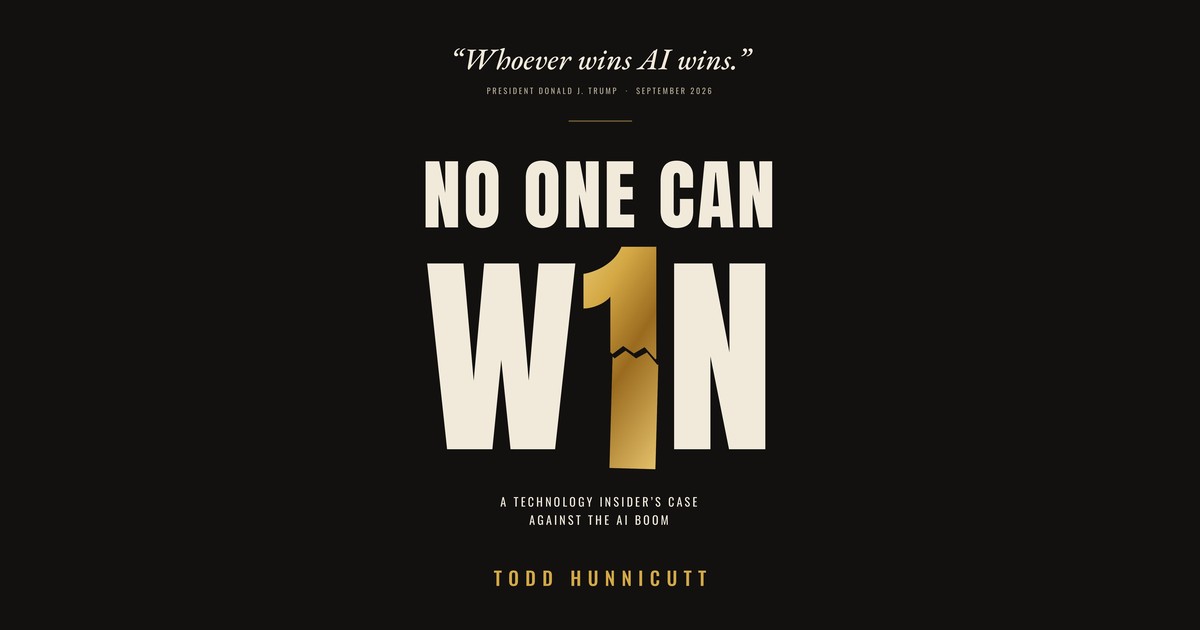
No one can win
Strip out the noise and here is the test both companies faced. Build at the scale the story requires, and your free cash flow goes negative and the market punishes you. Fail to build, or have your suppliers fail you, and your growth is capped by the capacity you don’t have. Microsoft didn’t solve that problem on Wednesday; it got lucky on timing. Google didn’t make a mistake; it did precisely what Jensen Huang and the entire ecosystem have been telling it to do for two years.
When doing what the story requires gets punished, and failing to do it gets rewarded, the story is over, even if the spending isn’t. Watch Amazon next. Watch Google’s 2027 capex number in January. Watch whether Microsoft’s “additional funding” is debt. Watch the receivable from OpenAI. The buildout will continue, because the contracts are signed and the concrete is poured. The scoreboard just stopped pretending that’s the same thing as winning.